
Crawl Space Encapsulation Specialist Beaufort County, SC
Beaufort County sits on an archipelago of tidal sea islands where the ground under most homes behaves nothing like the ground under a house in the Upstate. The USDA Natural Resources Conservation Service classifies roughly 73 percent of the county’s soils as hydric, meaning they stay saturated through most of the growing season and shed almost nothing downward. Add 45 to 55 inches of annual rainfall, a seasonal high water table that sits within a few feet of the surface across much of Lady’s Island, St. Helena and the Bluffton corridor, and summer dew points that hold in the low 70s for weeks, and a vented crawl space stops being a ventilation strategy and becomes a moisture pump. Homeowners from Port Royal to Hilton Head Island tend to notice the results upstairs first: a musty draft from the floor registers, cupped hardwood, doors that stick from June through September. Understanding why that happens under a Lowcountry home is the first step toward fixing it.
Contact Us
Beaufort County, SC Crawl Space & Moisture Management
We focus on professional crawl space encapsulation and foundation moisture control. We help address high humidity, damp insulation, and vapor barrier issues across Beaufort County, SC. Anything you need related to moisture management, we can help coordinate effective solutions for your Beaufort County home.
The crawl space is a critical part of your home’s structure. You need your home to be a safe, dry environment for your family, so you are going to want reliable and effective foundation services. Finding a leading crawl space encapsulation contractor in Beaufort County, SC is the first step toward a healthy home.
About Us
The work is straightforward in principle: diagnose the actual moisture mechanism under the home, address bulk water and drainage before anything is sealed, build to what Section R408.3 of the 2021 International Residential Code and the applicable flood zone regulations require, and choose materials that hold up in a salt-air marine environment. Homeowners are told what was measured and why a particular approach is being recommended, in plain language.
Our Services
Crawl space moisture services for homes across Beaufort County, South Carolina.
Crawl Space Encapsulation
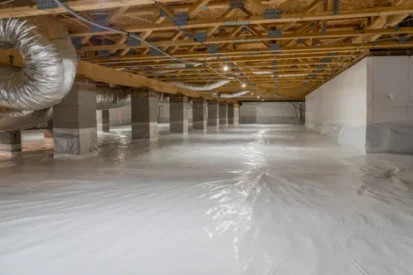
Crawl space encapsulation is the process of converting a vented crawl space into a sealed, conditioned part of the building envelope. In Beaufort County that conversion is not optional cosmetics — it is a direct response to the fact that roughly 73 percent of the county’s soils are hydric and stay saturated for most of the growing season, while summer dew points hold high enough that outside air entering a foundation vent condenses the moment it touches the cooler subfloor. A complete encapsulation addresses bulk water and drainage first, cleans and dries the space, then installs a continuous reinforced vapor retarder across the exposed earth and up the foundation walls, with joints lapped and sealed and the assembly terminated so the three-inch visual inspection gap along the wall remains intact for pest inspection. The sealed envelope is then conditioned by one of the four methods Section R408.3 of the 2021 International Residential Code recognizes. Skipping that final step is the most common reason a sealed crawl space in this county still reads high on a moisture meter a year later.
Dehumidification & Moisture Control
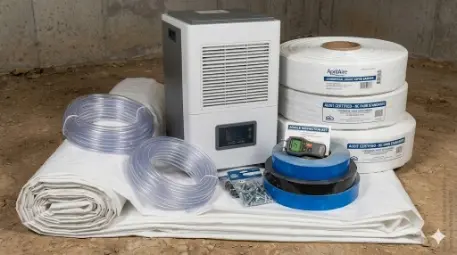
Crawl space dehumidification is the mechanical management of the air inside a sealed crawl space, and under Section R408.3 of the 2021 International Residential Code it is one of four recognized methods of conditioning a closed crawl space — alongside continuously operated exhaust ventilation at 1 CFM per 50 square feet of floor area, conditioned supply air from the home’s HVAC system at the same ratio, and use of the under-floor space as a plenum where the mechanical code allows. In Beaufort County it is the method most homes end up using, because the residual moisture load in a Lowcountry crawl space after sealing is significant: the soil beneath the barrier is saturated, the framing has been cycling moisture for years, and the surrounding air outside the envelope stays near saturation for months. A unit sized to the volume of the space holds the substructure in a range where wood moisture content stabilizes rather than climbing back.
Vapor Barrier Installation
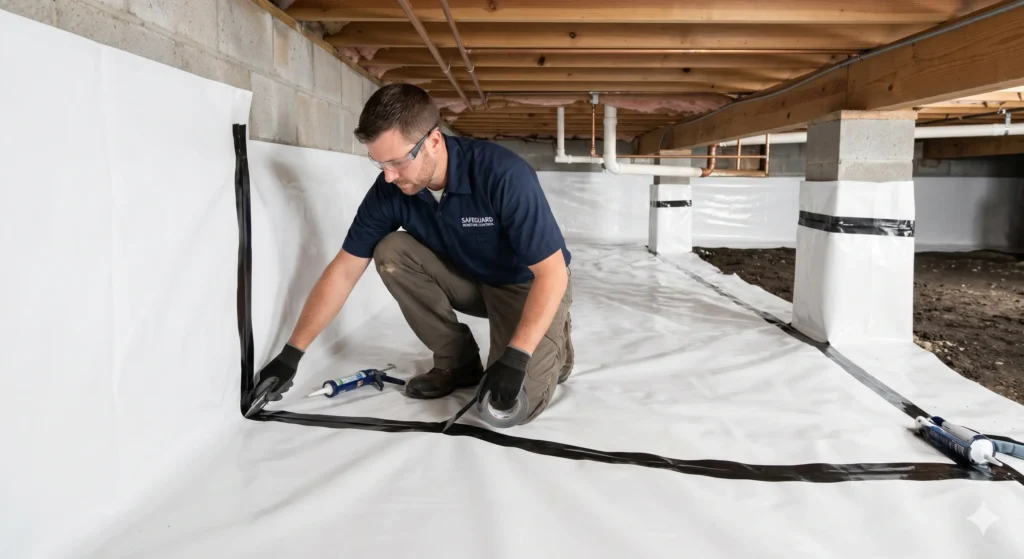
A vapor barrier is the sheeting laid over the exposed earth in a crawl space to stop soil moisture from evaporating upward into the substructure. In Beaufort County it does more work than it does almost anywhere else, because it is covering ground that is saturated for a large part of the year. Where a barrier over well-drained sand is managing intermittent vapor, a barrier over a hydric soil on Lady’s Island or in the Okatie corridor is holding back a near-constant source. That is why specification matters here: Section R408.3 of the 2021 International Residential Code calls for a continuous Class I vapor retarder with joints lapped and sealed, and professional installations commonly use reinforced material considerably heavier than the 6-mil minimum because thin unsealed liners tear during service work, float, and separate at the seams over saturated ground.
Crawl Space Insulation
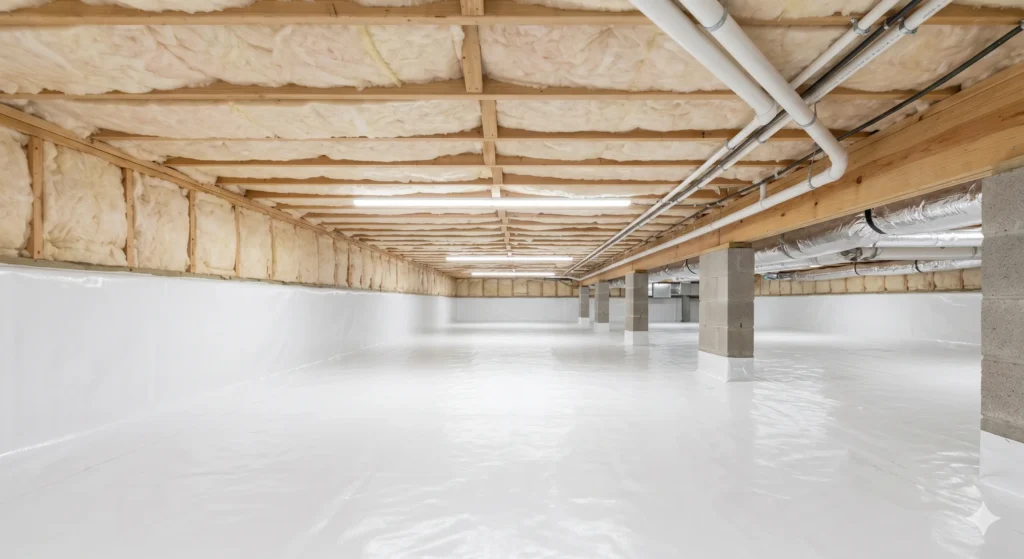
Crawl space insulation in Beaufort County is governed by both energy code and fire safety code, and the two pull in different directions if the work is done carelessly. The county sits in IECC Climate Zone 3, and South Carolina’s energy standard sets the thermal resistance minimums that apply when a crawl space assembly is insulated. At the same time, when foam plastic insulation is used in a crawl space it is normally required to be separated from the space by an approved thermal barrier, with a specific exception in the residential code that applies only when defined conditions are met. The practical starting point on most Lowcountry retrofits is removal: fiberglass batts that have absorbed moisture sag off the subfloor, lose most of their rated performance, and can hold biological growth against the framing, so they come out before anything new goes in.
Mold Remediation
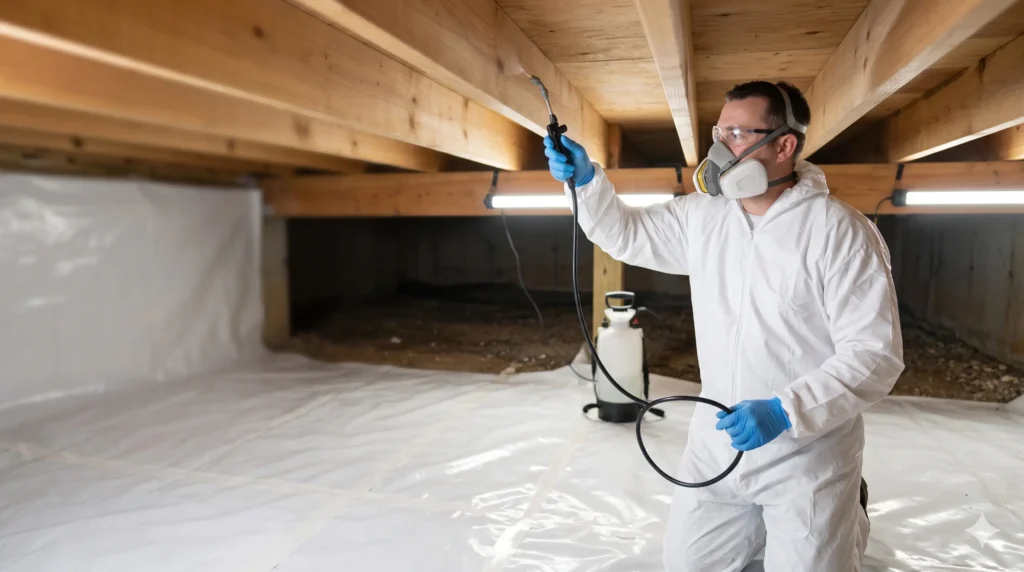
Mold in a Beaufort County crawl space is a symptom with a measurable cause. The metric that matters is wood moisture content in the joists, band board and sill plates: a stabilized substructure reads in the 12 to 16 percent range, and once readings climb past roughly 20 percent, surface molds and mildews can colonize exposed wood within a day or two of favorable conditions. The genera commonly found under homes in this county are Aspergillus, Penicillium and Cladosporium. Because of the stack effect, that growth does not stay under the house — a substantial share of the air in the first-floor living space originates in the crawl space, which is why the musty odor and the complaints usually start upstairs. Treatment addresses the growth on the framing; correcting the moisture mechanism is what keeps it from returning.

Foundation Code Compliance
We help coordinate assessments and technical guidance to keep your crawl space aligned with Section R408.3 of the 2021 International Residential Code unvented crawl space standards, which govern how sealed crawl spaces must be conditioned in Beaufort County properties.
Signs of a Foundation Moisture Problem
Most crawl space problems in the Lowcountry announce themselves inside the living space long before anyone opens the access hatch. Because of the stack effect, a large share of the air you breathe on the first floor was drawn up out of the crawl space, so whatever is happening down there is being delivered to the rooms above. If several of the conditions below sound familiar, especially if they worsen in the humid months rather than after a heavy rain, the mechanism is usually airborne moisture condensing on cool framing and ductwork rather than bulk water intrusion, and the two call for different responses.
“How Do I Know?” Checklist
- Musty Odors: A persistent, earthy smell in the living area, often strongest near floor vents. This is caused by the “Stack Effect,” where warm air rises and pulls damp, mold-spore-heavy air from the crawl space into your home.
- Cupping Hardwood Floors: When the bottom of a wood floor board absorbs more moisture than the top, the edges curl upward. This is a primary sign of high humidity in the sub-floor.
- Sweating HVAC Ducts: Cold air running through metal ducts in a hot, humid crawl space causes chronic condensation. This “sweat” drips onto insulation and wood, leading to rot.
- Visible Growth & Mildew: White or gray fuzzy growth on floor joists or the paper backing of fiberglass insulation is a clear indicator that humidity is consistently above 60%.
- High Indoor Humidity: If your air conditioner is running but the house still feels “sticky” or humid, your crawl space is likely acting as a reservoir of water vapor.
Frequently Asked Questions
Are closed crawl spaces allowed under South Carolina building code?
Yes. South Carolina permits both traditional vented and unvented (closed) crawl space designs, and Section R408.3 of the 2021 International Residential Code sets out what an unvented crawl space must include. The exposed earth must be covered with a continuous Class I vapor retarder with joints lapped and sealed, and the sealed space must be conditioned by one of four approved methods: continuously operated mechanical exhaust ventilation at 1 CFM per 50 square feet of floor area, conditioned air supplied from the home’s HVAC system at the same ratio, use of the under-floor space as a plenum where it complies with the mechanical code, or permanent mechanical dehumidification sized to the space. Sealing a crawl space without one of those four is not a code-compliant closed crawl space, and it is the most common shortcut homeowners in this county get sold.
Why does my house smell musty in the summer even when it hasn’t rained?
Because in Beaufort County the primary moisture threat is airborne, not rainfall. During the humid season the outdoor dew point routinely sits in the low 70s, and every foundation vent draws that saturated air into a crawl space where the subfloor, ductwork and plumbing are significantly cooler. The moisture condenses on those cool surfaces, wood moisture content climbs, and mold genera such as Aspergillus, Penicillium and Cladosporium colonize the framing. The stack effect then carries that air upward, which is why the odor is noticeable in the living space rather than the crawl space. A symptom that tracks the humidity rather than the rain generally points to this condensation mechanism.
Does encapsulation work if my home is in a flood zone?
It can, but the design changes and the flood zone has to be confirmed first. Much of Beaufort County near the Broad River, the tidal estuaries and the ocean falls inside a FEMA Special Flood Hazard Area. In an AE zone, an enclosed space below the Base Flood Elevation cannot be made watertight — it must be able to equalize hydrostatic pressure automatically during a flood event, which generally means engineered flood vents rather than simply sealing the openings. Contractors who close every vent in an AE zone can put a property out of compliance and affect its flood insurance rating. In VE zones, solid foundation walls enclosing the space are treated very differently again. The flood zone determination should come before any decision about sealing.
Do I still need a dehumidifier after the crawl space is sealed?
Usually, yes — in some form. Sealing the space stops new humid air from entering, but it does not remove the moisture already held in the soil, the framing and the air inside the envelope, and in this climate that residual load is substantial. That is why the code requires one of four air-management methods rather than treating the barrier as the whole solution. Permanent mechanical dehumidification is the method most Lowcountry homes end up using, sized to the cubic volume of the space rather than chosen off a shelf. Which method suits a particular home depends on its HVAC configuration, the crawl space volume, and whether ductwork already runs through the space.