
Crawl Space Cure Beaufort County Service Areas
Beaufort County is not one crawl space environment, it is several. A home on Fripp Island encircled by salt marsh, a home in Sun City over slow-draining hydric soil several miles inland, and an antebellum frame house in downtown Beaufort each face a different dominant mechanism, and each needs a different sequence of work. The pages below cover the specific conditions under homes in each community we serve — the soils, the water table behavior, the flood zone considerations and the symptom patterns homeowners in that area actually report.
Communities We Serve
Communities We Serve
Sea Islands & Barrier Coast
- Hilton Head Island — encircled by tidal creek and salt marsh, where salt aerosol and pluff-mud hydrogen sulfide move through foundation vents and corrode joist hangers, structural connectors and copper lines faster than anywhere inland.
- St. Helena Island — Gullah Geechee community homes on raised piers over persistently hydric ground, where generations of incremental repairs layer over one another and current moisture readings tell more than the visible history does.
- Dataw Island — a gated island ringed by tidal creek on every side, where marsh-air chemistry works on structural hardware independently of humidity and seasonal occupancy can hide a developing problem for months.
- Fripp Island — an open-Atlantic barrier island where ocean salt and marsh sulfide attack from both directions and FEMA VE-zone requirements constrain how a crawl space can be enclosed at all.
- Daufuskie Island — a ferry-only island where Sea Island marsh exposure meets real logistics, so material delivery and crew staging shape the work as much as the moisture findings do.
Beaufort & Port Royal
- City of Beaufort — antebellum timber framing along the Beaufort River that has cycled moisture for well over a century, needing retrofit detailing careful enough for old-growth heart pine and original sill plates.
- Port Royal — waterfront homes along Battery Creek where crawl space symptoms often track the tide cycle as closely as the rainfall, pointing toward hydrostatic pressure rather than airborne condensation alone.
- Lady’s Island — bounded by tidal creeks across the river from downtown Beaufort, where a shallow water table and marsh-edge exposure combine so drainage and air management usually have to be addressed together.
- Burton — decades of mixed infill between Beaufort and Port Royal over the same waterfront-linked hydric soil, where crawl space age and prior repair history vary sharply from block to block.
Bluffton & the Inland Corridor
- Bluffton — May River corridor homes where the musty complaint tracks the humid season rather than storms, marking condensation on the subfloor and ductwork as the dominant mechanism inland of the islands.
- Sun City — a 14,000-home community built within a narrow construction era, so an original moisture or ventilation shortcoming tends to surface across many homes at a similar point in their service life.
- Okatie — spanning Okatie River frontage and inland Highway 170 lots, where the dominant mechanism depends heavily on how close a property sits to tidal water versus slow-draining interior soil.
- Callawassie Island — a gated river community between the Colleton and Chechessee, carrying tidal influence without the full open-marsh exposure of the outer islands, where foundation grading varies considerably between adjacent lots.
- Spring Island — low-density wooded lots along the Chechessee where heavy canopy slows how quickly ground dries and conservation standards limit how much grading a homeowner can do around a foundation.
Northern & Rural Beaufort County
- Seabrook — rural, wooded northern lots where rainfall drives the moisture pattern more than marsh air does, and well and septic systems add localized saturation near the foundation.
- Sheldon — a historic agricultural community along the Broad and Whale Branch Rivers, where older homesteads were built to vented-crawl-space assumptions that predate current understanding of this region’s humidity load.
- Yemassee — a small rail and farming town on the Combahee within the ACE Basin, where crawl spaces have typically been in service far longer without any modern moisture retrofit.
Contact Crawl Space Cure Beaufort County
Our Services
Crawl space moisture services for homes across Beaufort County, South Carolina.
Crawl Space Encapsulation
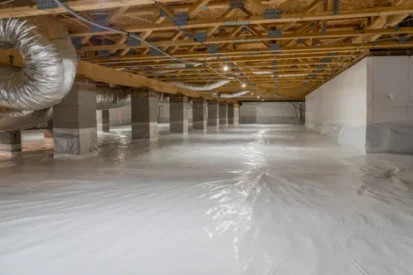
Crawl space encapsulation is the process of converting a vented crawl space into a sealed, conditioned part of the building envelope. In Beaufort County that conversion is not optional cosmetics — it is a direct response to the fact that roughly 73 percent of the county’s soils are hydric and stay saturated for most of the growing season, while summer dew points hold high enough that outside air entering a foundation vent condenses the moment it touches the cooler subfloor. A complete encapsulation addresses bulk water and drainage first, cleans and dries the space, then installs a continuous reinforced vapor retarder across the exposed earth and up the foundation walls, with joints lapped and sealed and the assembly terminated so the three-inch visual inspection gap along the wall remains intact for pest inspection. The sealed envelope is then conditioned by one of the four methods Section R408.3 of the 2021 International Residential Code recognizes. Skipping that final step is the most common reason a sealed crawl space in this county still reads high on a moisture meter a year later.
Dehumidification & Moisture Control
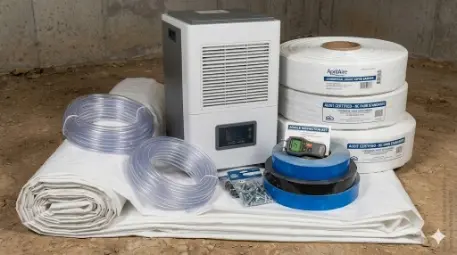
Crawl space dehumidification is the mechanical management of the air inside a sealed crawl space, and under Section R408.3 of the 2021 International Residential Code it is one of four recognized methods of conditioning a closed crawl space — alongside continuously operated exhaust ventilation at 1 CFM per 50 square feet of floor area, conditioned supply air from the home’s HVAC system at the same ratio, and use of the under-floor space as a plenum where the mechanical code allows. In Beaufort County it is the method most homes end up using, because the residual moisture load in a Lowcountry crawl space after sealing is significant: the soil beneath the barrier is saturated, the framing has been cycling moisture for years, and the surrounding air outside the envelope stays near saturation for months. A unit sized to the volume of the space holds the substructure in a range where wood moisture content stabilizes rather than climbing back.
Vapor Barrier Installation
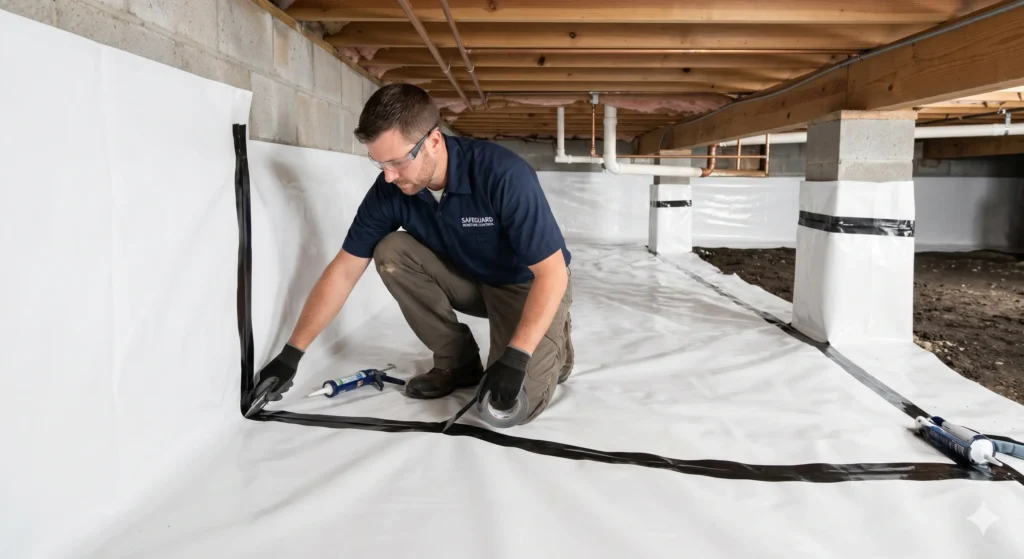
A vapor barrier is the sheeting laid over the exposed earth in a crawl space to stop soil moisture from evaporating upward into the substructure. In Beaufort County it does more work than it does almost anywhere else, because it is covering ground that is saturated for a large part of the year. Where a barrier over well-drained sand is managing intermittent vapor, a barrier over a hydric soil on Lady’s Island or in the Okatie corridor is holding back a near-constant source. That is why specification matters here: Section R408.3 of the 2021 International Residential Code calls for a continuous Class I vapor retarder with joints lapped and sealed, and professional installations commonly use reinforced material considerably heavier than the 6-mil minimum because thin unsealed liners tear during service work, float, and separate at the seams over saturated ground.
Crawl Space Insulation
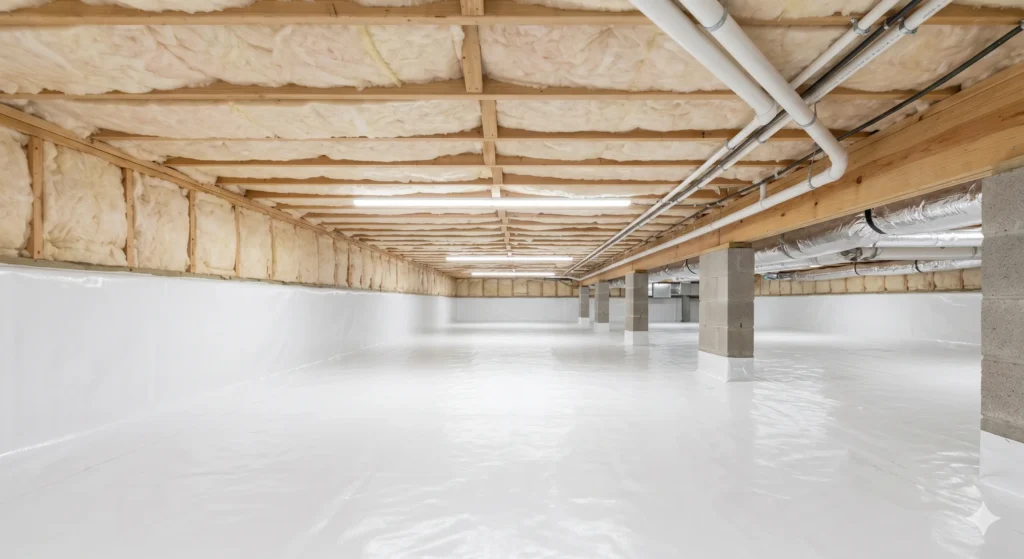
Crawl space insulation in Beaufort County is governed by both energy code and fire safety code, and the two pull in different directions if the work is done carelessly. The county sits in IECC Climate Zone 3, and South Carolina’s energy standard sets the thermal resistance minimums that apply when a crawl space assembly is insulated. At the same time, when foam plastic insulation is used in a crawl space it is normally required to be separated from the space by an approved thermal barrier, with a specific exception in the residential code that applies only when defined conditions are met. The practical starting point on most Lowcountry retrofits is removal: fiberglass batts that have absorbed moisture sag off the subfloor, lose most of their rated performance, and can hold biological growth against the framing, so they come out before anything new goes in.
Mold Remediation
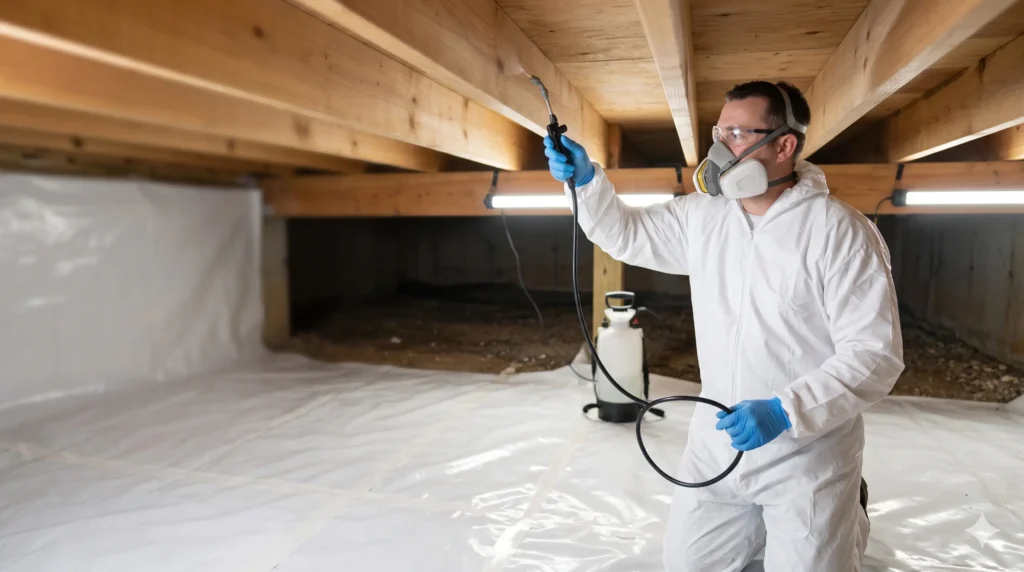
Mold in a Beaufort County crawl space is a symptom with a measurable cause. The metric that matters is wood moisture content in the joists, band board and sill plates: a stabilized substructure reads in the 12 to 16 percent range, and once readings climb past roughly 20 percent, surface molds and mildews can colonize exposed wood within a day or two of favorable conditions. The genera commonly found under homes in this county are Aspergillus, Penicillium and Cladosporium. Because of the stack effect, that growth does not stay under the house — a substantial share of the air in the first-floor living space originates in the crawl space, which is why the musty odor and the complaints usually start upstairs. Treatment addresses the growth on the framing; correcting the moisture mechanism is what keeps it from returning.

Foundation Code Compliance
We help coordinate assessments and technical guidance to keep your crawl space aligned with Section R408.3 of the 2021 International Residential Code unvented crawl space standards, which govern how sealed crawl spaces must be conditioned in Beaufort County properties.
Ready for a Free Beaufort County Crawl Space Inspection?
A free crawl space inspection tells you what is actually happening under your home — wood moisture content readings on the joists and sill plates, where the moisture is entering, whether your property sits in an AE or VE flood zone, and what a code-compliant solution would involve. There is no cost and no obligation, and accurate pricing for your specific property can only be provided after that inspection.